

Choice Made Simple!
Too many options?Click below to purchase an online gift card that can be used at participating retailers in Village Green Shopping Centre and continue your shopping IN CENTRE!Purchase HereHome
G Protein Methods and Protocols by Ram K. MISHRA, Hardcover | Indigo Chapters
Coles
Loading Inventory...
G Protein Methods and Protocols by Ram K. MISHRA, Hardcover | Indigo Chapters in Vernon, BC
By Ram K. MISHRA
Current price: $248.50
Coles
G Protein Methods and Protocols by Ram K. MISHRA, Hardcover | Indigo Chapters in Vernon, BC
By Ram K. MISHRA
Current price: $248.50
Loading Inventory...
Size: 1 x 9.25 x 1.83
*Product information may vary - to confirm product availability, pricing, shipping and return information please contact Coles
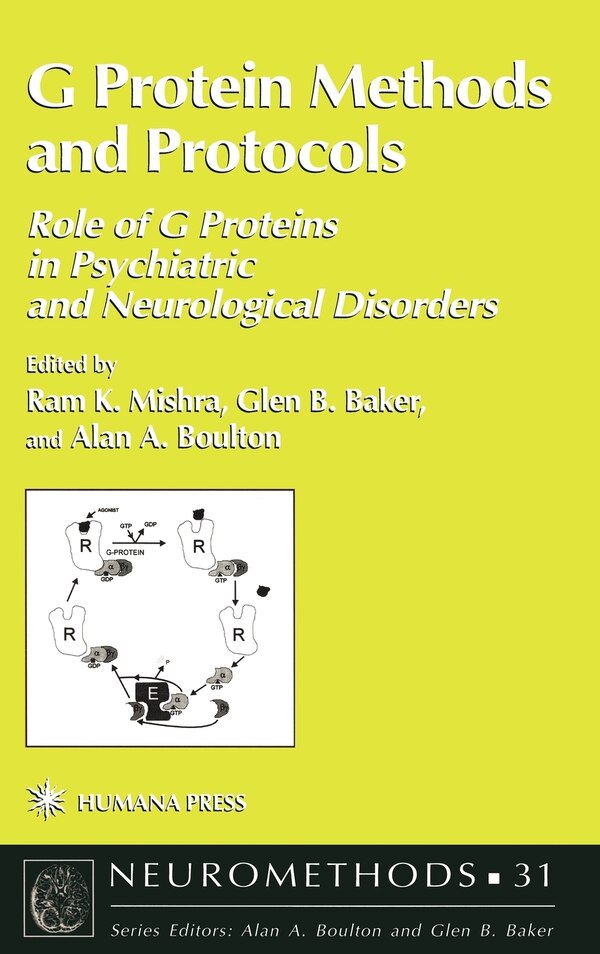
The G proteins are a family of structurally homologous, plasma membrane-associated guanine-nucleotide-binding proteins. These proteins play an integral role in the tra- duction of extracellular signals through second messenger systems. As such, G proteins affect a wide variety of intra cellular biochemical reactions by regulating the concent- tion of second messengers in cells. G proteins are heterotrimeric, consisting of a, p, and y polypeptide chains, with G protein specificity largely det- mined by the a-subunit, Molecular cloning of G protein s- units has revealed 23 distinct a-subunits, encoded by 17 different genes. Based on functional measures, G proteins are generally classified into three major categories: the G, family, which is stimulatory for adenylyl cyclase; the G, f- ily, which is inhibitory for adenylyl cyclase; and the G, f- ily, which stimulates phospholipases (Birnbaumer and Birnbaumer, 1995). Alternatively, on the basis of sequence homology, G proteins can be subdivided into four cate- ries: G, G, G, and G12. | G Protein Methods and Protocols by Ram K. MISHRA, Hardcover | Indigo Chapters
The G proteins are a family of structurally homologous, plasma membrane-associated guanine-nucleotide-binding proteins. These proteins play an integral role in the tra- duction of extracellular signals through second messenger systems. As such, G proteins affect a wide variety of intra cellular biochemical reactions by regulating the concent- tion of second messengers in cells. G proteins are heterotrimeric, consisting of a, p, and y polypeptide chains, with G protein specificity largely det- mined by the a-subunit, Molecular cloning of G protein s- units has revealed 23 distinct a-subunits, encoded by 17 different genes. Based on functional measures, G proteins are generally classified into three major categories: the G, family, which is stimulatory for adenylyl cyclase; the G, f- ily, which is inhibitory for adenylyl cyclase; and the G, f- ily, which stimulates phospholipases (Birnbaumer and Birnbaumer, 1995). Alternatively, on the basis of sequence homology, G proteins can be subdivided into four cate- ries: G, G, G, and G12. | G Protein Methods and Protocols by Ram K. MISHRA, Hardcover | Indigo Chapters
You May Also Like











More About Coles at Village Green Shopping Centre
Find everything in-store including new, used and children’s books, music, movies, games and toys. Visit Coles today to find the perfect gift, or a novel for yourself. COVID-19 UPDATE: Open | Regular Centre Hours
Store Info
Find Coles at Village Green Shopping Centre in Vernon, BC
Visit Coles at Village Green Shopping Centre in Vernon, BC