

Choice Made Simple!
Too many options?Click below to purchase an online gift card that can be used at participating retailers in Village Green Shopping Centre and continue your shopping IN CENTRE!Purchase HereHome
The Moral Economy by Samuel Bowles, Paperback | Indigo Chapters
Coles
Loading Inventory...
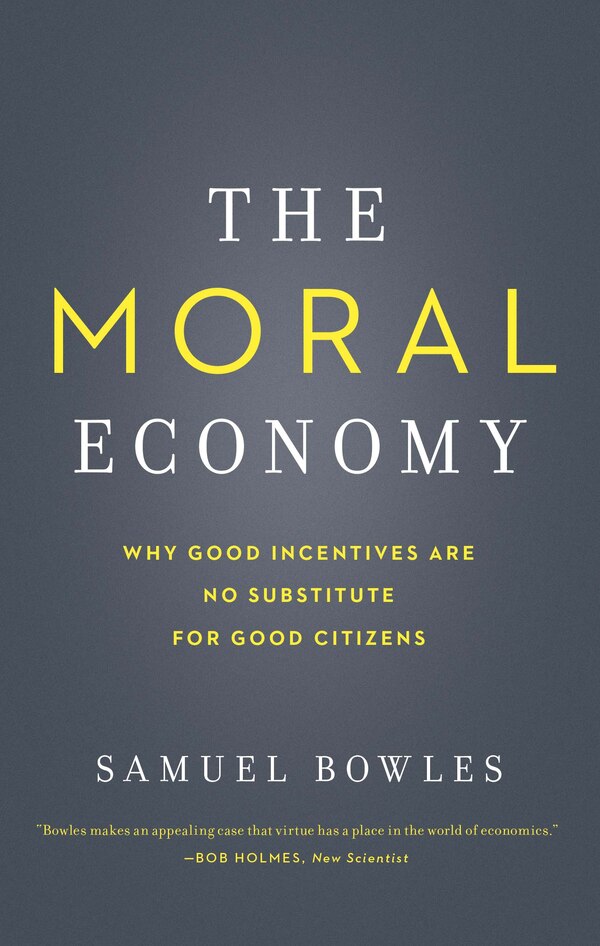
The Moral Economy by Samuel Bowles, Paperback | Indigo Chapters in Vernon, BC
By Samuel Bowles
Current price: $27.50
Coles
The Moral Economy by Samuel Bowles, Paperback | Indigo Chapters in Vernon, BC
By Samuel Bowles
Current price: $27.50
Loading Inventory...
Size: 1 x 8 x 0.8
*Product information may vary - to confirm product availability, pricing, shipping and return information please contact Coles
Why do policies and business practices that ignore the moral and generous side of human nature often fail? Should the idea of economic man—the amoral and self-interested Homo economicus—determine how we expect people to respond to monetary rewards, punishments, and other incentives? Samuel Bowles answers with a resounding no. Policies that follow from this paradigm, he shows, may crowd out ethical and generous motives and thus backfire. But incentives per se are not really the culprit. Bowles shows that crowding out occurs when the message conveyed by fines and rewards is that self-interest is expected, that the employer thinks the workforce is lazy, or that the citizen cannot otherwise be trusted to contribute to the public good. Using historical and recent case studies as well as behavioral experiments, Bowles shows how well-designed incentives can crowd in the civic motives on which good governance depends. | The Moral Economy by Samuel Bowles, Paperback | Indigo Chapters
Why do policies and business practices that ignore the moral and generous side of human nature often fail? Should the idea of economic man—the amoral and self-interested Homo economicus—determine how we expect people to respond to monetary rewards, punishments, and other incentives? Samuel Bowles answers with a resounding no. Policies that follow from this paradigm, he shows, may crowd out ethical and generous motives and thus backfire. But incentives per se are not really the culprit. Bowles shows that crowding out occurs when the message conveyed by fines and rewards is that self-interest is expected, that the employer thinks the workforce is lazy, or that the citizen cannot otherwise be trusted to contribute to the public good. Using historical and recent case studies as well as behavioral experiments, Bowles shows how well-designed incentives can crowd in the civic motives on which good governance depends. | The Moral Economy by Samuel Bowles, Paperback | Indigo Chapters
You May Also Like













More About Coles at Village Green Shopping Centre
Find everything in-store including new, used and children’s books, music, movies, games and toys. Visit Coles today to find the perfect gift, or a novel for yourself. COVID-19 UPDATE: Open | Regular Centre Hours
Store Info
Find Coles at Village Green Shopping Centre in Vernon, BC
Visit Coles at Village Green Shopping Centre in Vernon, BC