

Choice Made Simple!
Too many options?Click below to purchase an online gift card that can be used at participating retailers in Village Green Shopping Centre and continue your shopping IN CENTRE!Purchase HereHome
New Approaches to Reliability Qualification of Semiconductor Components under Varying and Progressive Stresses
Coles
Loading Inventory...
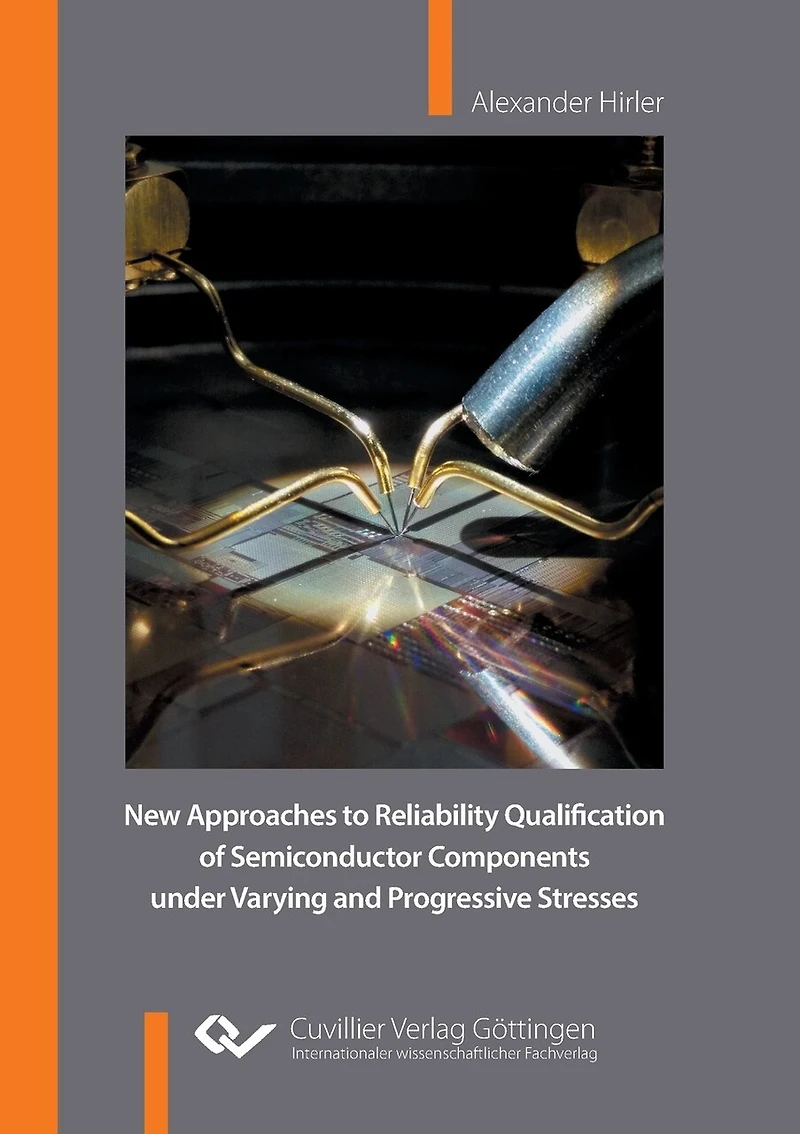
New Approaches to Reliability Qualification of Semiconductor Components under Varying and Progressive Stresses in Vernon, BC
By None
Current price: $79.50
Coles
New Approaches to Reliability Qualification of Semiconductor Components under Varying and Progressive Stresses in Vernon, BC
By None
Current price: $79.50
Loading Inventory...
Size: Paperback
*Product information may vary - to confirm product availability, pricing, shipping and return information please contact Coles
In the present work, urgent issues in the reliability qualification of semiconductor devices are addressed, which particularly affect value chains such as those in the automotive industry. These have particularly high requirements for long lifetime and low failure rates of their products, which are additionally exposed to more extreme operating and environmental conditions than in most other areas of application. In particular, the question arises on how to assess a product or semiconductor technology against the requirement of an application-specific mission profile with multiple non-constant stressors. For this purpose, the behavior of failure distributions under varying and progressive stress loads is investigated and described using cumulative damage models. For the first time, the industry-wide approach of transforming non-constant mission profiles into effective constant stress and test conditions for reliability assessment and qualification can be physically justified and substantiated with measurement data. This stress transformation is exemplified using the time-dependent dielectric breakdown (TDDB) failure mechanism with the two stressors voltage and temperature; and then extended to include the use of multi-dimensional mission profiles and interdependent stressors. These measurements are performed on university metal-oxide-semiconductor (MOS) capacitors as well as on commercially available state-of-the-art transistors. Finally, it is demonstrated that the obtained findings in the field of cumulative damage can be applied to use reliability studies with ramp-stress for acceleration model verification and to determine model parameters with less time and experimental effort
In the present work, urgent issues in the reliability qualification of semiconductor devices are addressed, which particularly affect value chains such as those in the automotive industry. These have particularly high requirements for long lifetime and low failure rates of their products, which are additionally exposed to more extreme operating and environmental conditions than in most other areas of application. In particular, the question arises on how to assess a product or semiconductor technology against the requirement of an application-specific mission profile with multiple non-constant stressors. For this purpose, the behavior of failure distributions under varying and progressive stress loads is investigated and described using cumulative damage models. For the first time, the industry-wide approach of transforming non-constant mission profiles into effective constant stress and test conditions for reliability assessment and qualification can be physically justified and substantiated with measurement data. This stress transformation is exemplified using the time-dependent dielectric breakdown (TDDB) failure mechanism with the two stressors voltage and temperature; and then extended to include the use of multi-dimensional mission profiles and interdependent stressors. These measurements are performed on university metal-oxide-semiconductor (MOS) capacitors as well as on commercially available state-of-the-art transistors. Finally, it is demonstrated that the obtained findings in the field of cumulative damage can be applied to use reliability studies with ramp-stress for acceleration model verification and to determine model parameters with less time and experimental effort
You May Also Like














More About Coles at Village Green Shopping Centre
Find everything in-store including new, used and children’s books, music, movies, games and toys. Visit Coles today to find the perfect gift, or a novel for yourself. COVID-19 UPDATE: Open | Regular Centre Hours
Store Info
Find Coles at Village Green Shopping Centre in Vernon, BC
Visit Coles at Village Green Shopping Centre in Vernon, BC