

Choice Made Simple!
Too many options?Click below to purchase an online gift card that can be used at participating retailers in Village Green Shopping Centre and continue your shopping IN CENTRE!Purchase HereHome
How Reform Worked In China by Yingyi Qian, Paperback | Indigo Chapters
Coles
Loading Inventory...
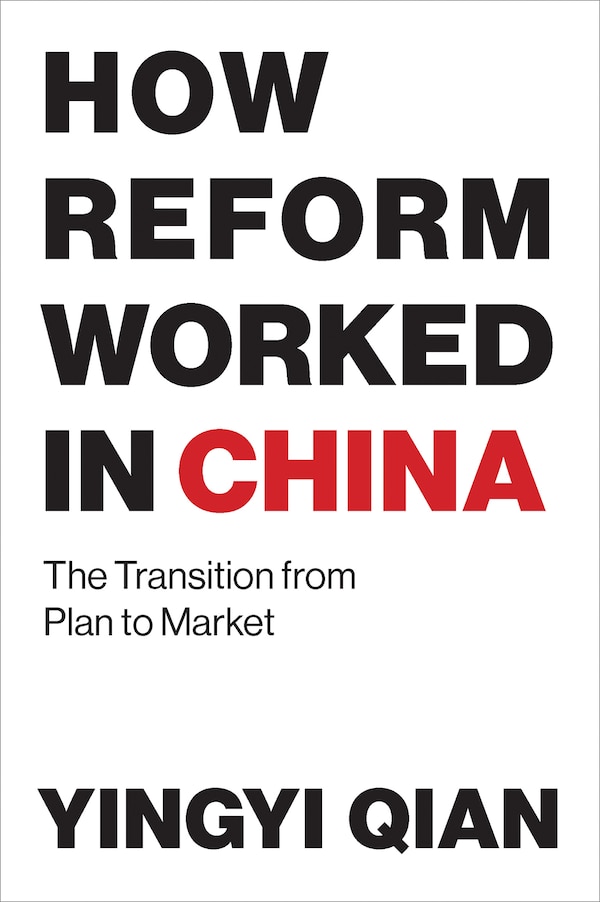
How Reform Worked In China by Yingyi Qian, Paperback | Indigo Chapters in Vernon, BC
By Yingyi Qian
Current price: $105.00
Coles
How Reform Worked In China by Yingyi Qian, Paperback | Indigo Chapters in Vernon, BC
By Yingyi Qian
Current price: $105.00
Loading Inventory...
Size: 1 x 9 x 0.8125
*Product information may vary - to confirm product availability, pricing, shipping and return information please contact Coles
A noted Chinese economist examines the mechanisms behind China's economic reforms, arguing that universal principles and specific implementations are equally important. As China has transformed itself from a centrally planned economy to a market economy, economists have tried to understand and interpret the success of Chinese reform. As the Chinese economist Yingyi Qian explains, there are two schools of thought on Chinese reform: the School of Universal Principles, which ascribes China's successful reform to the workings of the free market, and the School of Chinese Characteristics, which holds that China's reform is successful precisely because it did not follow the economics of the market but instead relied on the government. In this book, Qian offers a third perspective, taking certain elements from each school of thought but emphasizing not why reform worked but how it did. Economics is a science, but economic reform is applied science and engineering. To a practitioner, it is more useful to find a feasible reform path than the theoretically best way. The key to understanding how reform has worked in China, Qian argues, is to consider the way reform designs respond to initial historical conditions and contemporary constraints. Qian examines the role of transitional institutions—not best practice institutions but incentive-compatible institutions—in Chinese reform; the dual-track approach to market liberalization; the ownership of firms, viewed both theoretically and empirically; government decentralization, offering and testing hypotheses about its link to local economic development; and the specific historical conditions of China's regional-based central planning. | How Reform Worked In China by Yingyi Qian, Paperback | Indigo Chapters
A noted Chinese economist examines the mechanisms behind China's economic reforms, arguing that universal principles and specific implementations are equally important. As China has transformed itself from a centrally planned economy to a market economy, economists have tried to understand and interpret the success of Chinese reform. As the Chinese economist Yingyi Qian explains, there are two schools of thought on Chinese reform: the School of Universal Principles, which ascribes China's successful reform to the workings of the free market, and the School of Chinese Characteristics, which holds that China's reform is successful precisely because it did not follow the economics of the market but instead relied on the government. In this book, Qian offers a third perspective, taking certain elements from each school of thought but emphasizing not why reform worked but how it did. Economics is a science, but economic reform is applied science and engineering. To a practitioner, it is more useful to find a feasible reform path than the theoretically best way. The key to understanding how reform has worked in China, Qian argues, is to consider the way reform designs respond to initial historical conditions and contemporary constraints. Qian examines the role of transitional institutions—not best practice institutions but incentive-compatible institutions—in Chinese reform; the dual-track approach to market liberalization; the ownership of firms, viewed both theoretically and empirically; government decentralization, offering and testing hypotheses about its link to local economic development; and the specific historical conditions of China's regional-based central planning. | How Reform Worked In China by Yingyi Qian, Paperback | Indigo Chapters
You May Also Like











More About Coles at Village Green Shopping Centre
Find everything in-store including new, used and children’s books, music, movies, games and toys. Visit Coles today to find the perfect gift, or a novel for yourself. COVID-19 UPDATE: Open | Regular Centre Hours
Store Info
Find Coles at Village Green Shopping Centre in Vernon, BC
Visit Coles at Village Green Shopping Centre in Vernon, BC