

Choice Made Simple!
Too many options?Click below to purchase an online gift card that can be used at participating retailers in Village Green Shopping Centre and continue your shopping IN CENTRE!Purchase HereHome
Flesh and Spirit in the Songs of Homer by Michael Clarke, Hardcover | Indigo Chapters
Coles
Loading Inventory...
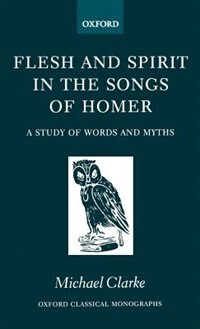
Flesh and Spirit in the Songs of Homer by Michael Clarke, Hardcover | Indigo Chapters in Vernon, BC
By Michael Clarke
Current price: $360.00
Coles
Flesh and Spirit in the Songs of Homer by Michael Clarke, Hardcover | Indigo Chapters in Vernon, BC
By Michael Clarke
Current price: $360.00
Loading Inventory...
Size: 2.6 x 21.4 x 590
*Product information may vary - to confirm product availability, pricing, shipping and return information please contact Coles
In the epics of Homer people experience emotions, carry out thought, express themselves, suffer death, and survive in a shadowy afterlife. When Homer describes these processes he reveals his sense of human identity; his conception of the self and its relation to the visible body. Despitemany generations of study a fully satisfactory account of that conception has never been offered, partly because analyses of word-meanings, world-picture, and literary tradition have proceeded along separate paths. This book offers a newly integrated interpretation of Homeric man. The author starts with the working hypothesis that, in this poetry, the human being is not divided into two parts - inner and outer; body and soul; flesh and spirit - but stands as an indivisible unity. Thought and emotion areprecisely the same as the movement of breath, blood, and fluids in the breast; the thinking self and the visible flesh are inextricably united, with no sense of man having either a mind or a body as a constituent part of himself; and at death the journey to the Underworld is fundamentally the sameas the descent of the corpse into the soil. The last part of this analysis leads to a reassessment of the Homeric psuche, an entity which leaves the mouth at death and whose name is often misleadingly translated as soul. This study of the psuche leads to a new view of life in the Underworld, withwider implications for the study of the interrelation between myth, poetic narrative, and the meanings of early Greek words. | Flesh and Spirit in the Songs of Homer by Michael Clarke, Hardcover | Indigo Chapters
In the epics of Homer people experience emotions, carry out thought, express themselves, suffer death, and survive in a shadowy afterlife. When Homer describes these processes he reveals his sense of human identity; his conception of the self and its relation to the visible body. Despitemany generations of study a fully satisfactory account of that conception has never been offered, partly because analyses of word-meanings, world-picture, and literary tradition have proceeded along separate paths. This book offers a newly integrated interpretation of Homeric man. The author starts with the working hypothesis that, in this poetry, the human being is not divided into two parts - inner and outer; body and soul; flesh and spirit - but stands as an indivisible unity. Thought and emotion areprecisely the same as the movement of breath, blood, and fluids in the breast; the thinking self and the visible flesh are inextricably united, with no sense of man having either a mind or a body as a constituent part of himself; and at death the journey to the Underworld is fundamentally the sameas the descent of the corpse into the soil. The last part of this analysis leads to a reassessment of the Homeric psuche, an entity which leaves the mouth at death and whose name is often misleadingly translated as soul. This study of the psuche leads to a new view of life in the Underworld, withwider implications for the study of the interrelation between myth, poetic narrative, and the meanings of early Greek words. | Flesh and Spirit in the Songs of Homer by Michael Clarke, Hardcover | Indigo Chapters
You May Also Like











More About Coles at Village Green Shopping Centre
Find everything in-store including new, used and children’s books, music, movies, games and toys. Visit Coles today to find the perfect gift, or a novel for yourself. COVID-19 UPDATE: Open | Regular Centre Hours
Store Info
Find Coles at Village Green Shopping Centre in Vernon, BC
Visit Coles at Village Green Shopping Centre in Vernon, BC