

Choice Made Simple!
Too many options?Click below to purchase an online gift card that can be used at participating retailers in Village Green Shopping Centre and continue your shopping IN CENTRE!Purchase HereHome
Cognitive Carpentry by John L. Pollock, Paperback | Indigo Chapters
Coles
Loading Inventory...
Cognitive Carpentry by John L. Pollock, Paperback | Indigo Chapters in Vernon, BC
By John L. Pollock
Current price: $54.00
Coles
Cognitive Carpentry by John L. Pollock, Paperback | Indigo Chapters in Vernon, BC
By John L. Pollock
Current price: $54.00
Loading Inventory...
Size: 1 x 9 x 0.8125
*Product information may vary - to confirm product availability, pricing, shipping and return information please contact Coles
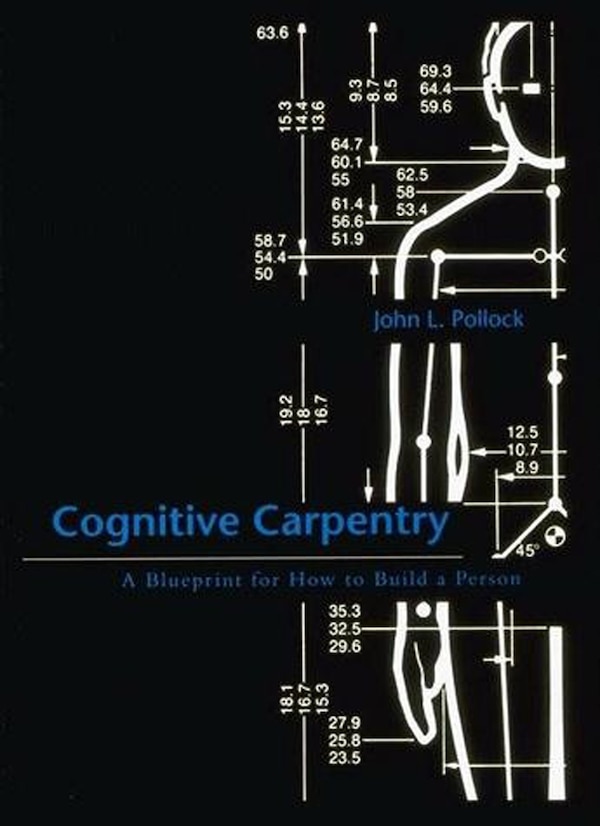
A sequel to Pollock's How to Build a Person, this volume builds upon that theoretical groundwork for the implementation of rationality through artificial intelligence. Pollock argues that progress in AI has stalled because of its creators' reliance upon unformulated intuitions about rationality. Instead, he bases the OSCAR architecture upon an explicit philosophical theory of rationality, encompassing principles of practical cognition, epistemic cognition, and defeasible reasoning. In his groundbreaking new book, John Pollock establishes an outpost at the crossroads where artificial intelligence meets philosophy. Specifically, he proposes a general theory of rationality and then describes its implementation in OSCAR, an architecture for an autonomous rational agent he claims is the first AI system capable of performing reasoning that philosophers would regard as epistemically sophisticated. A sequel to Pollock's How to Build a Person, this volume builds upon that theoretical groundwork for the implementation of rationality through artificial intelligence. Pollock argues that progress in AI has stalled because of its creators' reliance upon unformulated intuitions about rationality. Instead, he bases the OSCAR architecture upon an explicit philosophical theory of rationality, encompassing principles of practical cognition, epistemic cognition, and defeasible reasoning. One of the results is the world's first automated defeasible reasoner capable of reasoning in a rich, logical environment. Underlying Pollock's thesis is a conviction that the tenets of artifical intelligence and those of philosophy can be complementary and mutually beneficial. And, while members of both camps have in recent years grown skeptical of the very possibility of symbol processing AI, Cognitive Carpentry establishes that such an approach to AI can be successful. A Bradford Book | Cognitive Carpentry by John L. Pollock, Paperback | Indigo Chapters
A sequel to Pollock's How to Build a Person, this volume builds upon that theoretical groundwork for the implementation of rationality through artificial intelligence. Pollock argues that progress in AI has stalled because of its creators' reliance upon unformulated intuitions about rationality. Instead, he bases the OSCAR architecture upon an explicit philosophical theory of rationality, encompassing principles of practical cognition, epistemic cognition, and defeasible reasoning. In his groundbreaking new book, John Pollock establishes an outpost at the crossroads where artificial intelligence meets philosophy. Specifically, he proposes a general theory of rationality and then describes its implementation in OSCAR, an architecture for an autonomous rational agent he claims is the first AI system capable of performing reasoning that philosophers would regard as epistemically sophisticated. A sequel to Pollock's How to Build a Person, this volume builds upon that theoretical groundwork for the implementation of rationality through artificial intelligence. Pollock argues that progress in AI has stalled because of its creators' reliance upon unformulated intuitions about rationality. Instead, he bases the OSCAR architecture upon an explicit philosophical theory of rationality, encompassing principles of practical cognition, epistemic cognition, and defeasible reasoning. One of the results is the world's first automated defeasible reasoner capable of reasoning in a rich, logical environment. Underlying Pollock's thesis is a conviction that the tenets of artifical intelligence and those of philosophy can be complementary and mutually beneficial. And, while members of both camps have in recent years grown skeptical of the very possibility of symbol processing AI, Cognitive Carpentry establishes that such an approach to AI can be successful. A Bradford Book | Cognitive Carpentry by John L. Pollock, Paperback | Indigo Chapters
You May Also Like














More About Coles at Village Green Shopping Centre
Find everything in-store including new, used and children’s books, music, movies, games and toys. Visit Coles today to find the perfect gift, or a novel for yourself. COVID-19 UPDATE: Open | Regular Centre Hours
Store Info
Find Coles at Village Green Shopping Centre in Vernon, BC
Visit Coles at Village Green Shopping Centre in Vernon, BC