

Choice Made Simple!
Too many options?Click below to purchase an online gift card that can be used at participating retailers in Village Green Shopping Centre and continue your shopping IN CENTRE!Purchase HereHome
Basic Calculus of Planetary Orbits and Interplanetary Flight: the Missions Voyagers, Cassini, Juno
Coles
Loading Inventory...
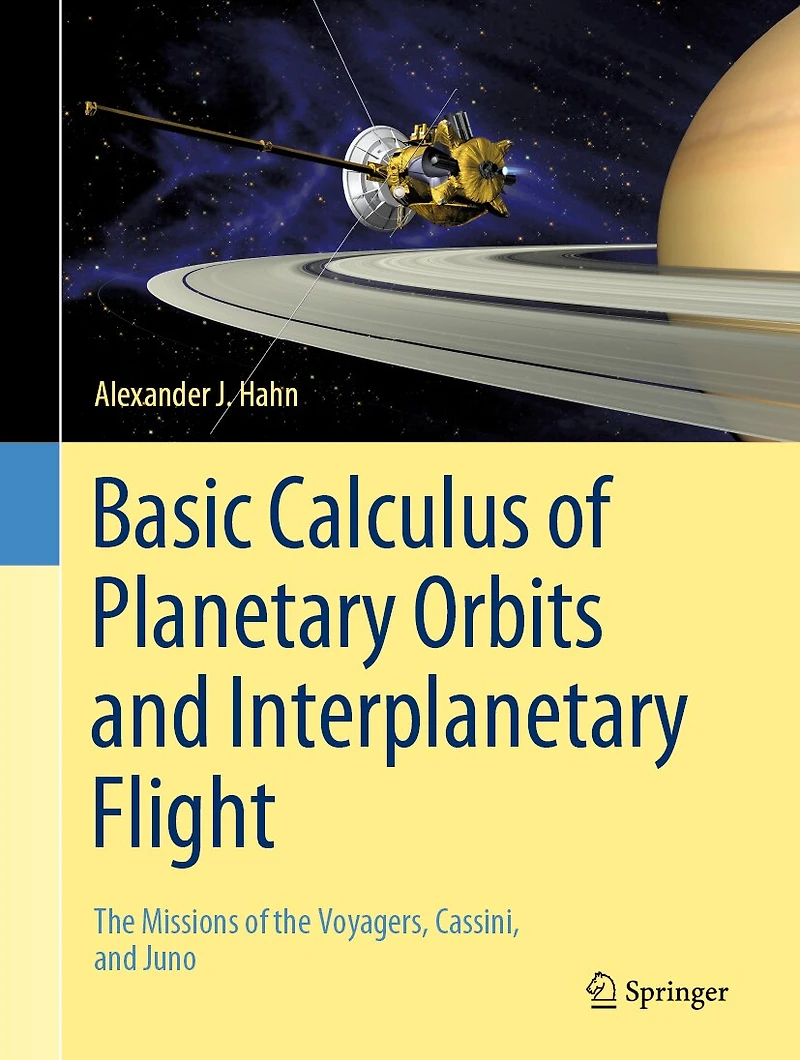
Basic Calculus of Planetary Orbits and Interplanetary Flight: the Missions Voyagers, Cassini, Juno in Vernon, BC
By None
Current price: $87.95
Coles
Basic Calculus of Planetary Orbits and Interplanetary Flight: the Missions Voyagers, Cassini, Juno in Vernon, BC
By None
Current price: $87.95
Loading Inventory...
Size: Hardcover
*Product information may vary - to confirm product availability, pricing, shipping and return information please contact Coles
Intended for a one- or two-semester course, this text applies basic, one-variable calculus to analyze the motion both of planets in their orbits as well as interplanetary spacecraft in their trajectories. The remarkable spacecraft missions to the inner and outermost reaches of our solar system have been one of the greatest success stories of modern human history. Much of the underlying mathematical story is presented alongside the astonishing images and extensive data that NASA's Voyager, NEAR-Shoemaker, Cassini, and Juno missions have sent back to us. First and second year college students in mathematics, engineering, or science, and those seeking an enriching independent study, will experience the mathematical language and methods of single variable calculus within their application to relevant conceptual and strategic aspects of the navigation of a spacecraft. The reader is expected to have taken one or two semesters of the basic calculus of derivatives, integrals, and the role that limits play. Additional prerequisites include knowledge of coordinate plane geometry, basic trigonometry, functions and graphs, including trig, inverse, exponential, and log functions. The discussions begin with the rich history of humanity's efforts to understand the universe from the Greeks, to Newton and the Scientific Revolution, to Hubble and galaxies, to NASA and the space missions. The calculus of polar functions that plays a central mathematical role is presented in a self-contained way in complete detail. Each of the six chapters is followed by an extensive problem set that deals with and also expands on the concerns of the chapter. The instructor has the flexibility to engage them with greater or lesser intensity. "I have been an aerospace engineer for 39 years and honestly, it would be hard for me to overstate how valuable I believe this book will be to numerous scientific and engineering disciplines and in particular to the future of aerospace engineering ... This book is perfectly crafted to motivate, educate, and prepare the scientists and engineers who wish to reach for the sky and beyond." -Dr. Mario Zoccoli, Aerospace Engineer, NASA and Lockheed Martin
Intended for a one- or two-semester course, this text applies basic, one-variable calculus to analyze the motion both of planets in their orbits as well as interplanetary spacecraft in their trajectories. The remarkable spacecraft missions to the inner and outermost reaches of our solar system have been one of the greatest success stories of modern human history. Much of the underlying mathematical story is presented alongside the astonishing images and extensive data that NASA's Voyager, NEAR-Shoemaker, Cassini, and Juno missions have sent back to us. First and second year college students in mathematics, engineering, or science, and those seeking an enriching independent study, will experience the mathematical language and methods of single variable calculus within their application to relevant conceptual and strategic aspects of the navigation of a spacecraft. The reader is expected to have taken one or two semesters of the basic calculus of derivatives, integrals, and the role that limits play. Additional prerequisites include knowledge of coordinate plane geometry, basic trigonometry, functions and graphs, including trig, inverse, exponential, and log functions. The discussions begin with the rich history of humanity's efforts to understand the universe from the Greeks, to Newton and the Scientific Revolution, to Hubble and galaxies, to NASA and the space missions. The calculus of polar functions that plays a central mathematical role is presented in a self-contained way in complete detail. Each of the six chapters is followed by an extensive problem set that deals with and also expands on the concerns of the chapter. The instructor has the flexibility to engage them with greater or lesser intensity. "I have been an aerospace engineer for 39 years and honestly, it would be hard for me to overstate how valuable I believe this book will be to numerous scientific and engineering disciplines and in particular to the future of aerospace engineering ... This book is perfectly crafted to motivate, educate, and prepare the scientists and engineers who wish to reach for the sky and beyond." -Dr. Mario Zoccoli, Aerospace Engineer, NASA and Lockheed Martin
You May Also Like














More About Coles at Village Green Shopping Centre
Find everything in-store including new, used and children’s books, music, movies, games and toys. Visit Coles today to find the perfect gift, or a novel for yourself. COVID-19 UPDATE: Open | Regular Centre Hours
Store Info
Find Coles at Village Green Shopping Centre in Vernon, BC
Visit Coles at Village Green Shopping Centre in Vernon, BC