Choice Made Simple!
Too many options?Click below to purchase an online gift card that can be used at participating retailers in Village Green Shopping Centre and continue your shopping IN CENTRE!Purchase Here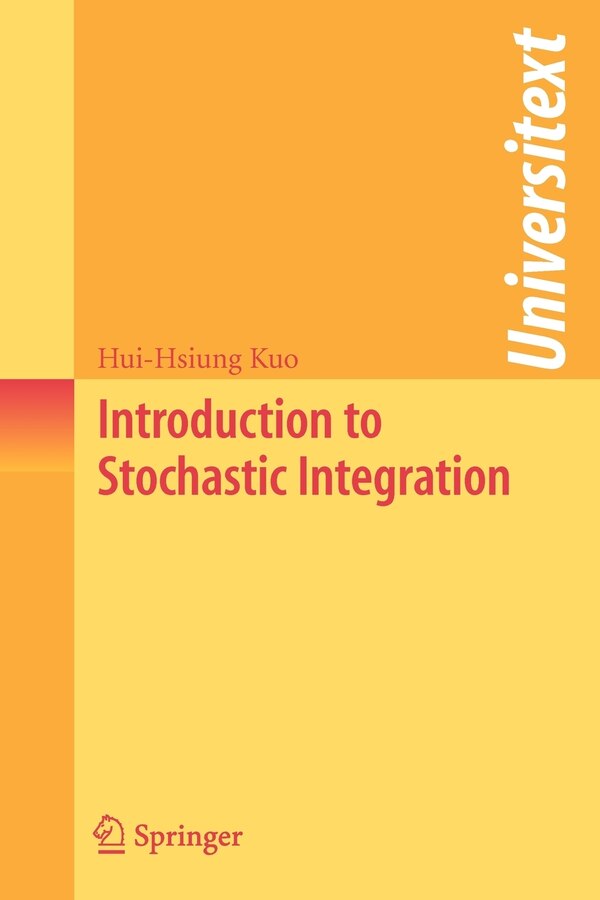
Compare Introduction To Stochastic Integration by Hui-hsiung Kuo, Paperback | Indigo Chapters
Hui-hsiung Kuo
$102.50
In the Leibniz-Newton calculus, one learns the di?erentiation and integration of deterministic functions. A basic theorem in di?erentiation is the chain rule, which gives the derivative of a composite of two di?erentiable functions. The chain rule, when written in an inde?nite integral form, yields the method of substitution. In advanced calculus, the Riemann-Stieltjes integral is de?ned through the same procedure of "partition-evaluation-summation-limit" as in the Riemann integral. In dealing with random functions such as functions of a Brownian motion, the chain rule for the Leibniz-Newton calculus breaks down. A Brownian motionmovessorapidlyandirregularlythatalmostallofitssamplepathsare nowhere di?erentiable. Thus we cannot di?erentiate functions of a Brownian motion in the same way as in the Leibniz-Newton calculus. In 1944 Kiyosi ItË o published the celebrated paper "Stochastic Integral" in the Proceedings of the Imperial Academy (Tokyo). It was the beginning of the ItË o calculus, the counterpart of the Leibniz-Newton calculus for random functions. In this six-page paper, ItË o introduced the stochastic integral and a formula, known since then as ItË o's formula. The ItË o formula is the chain rule for the ItËocalculus. Butitcannotbe expressed as in the Leibniz-Newton calculus in terms of derivatives, since a Brownian motion path is nowhere di?erentiable. The ItË o formula can be interpreted only in the integral form. Moreover, there is an additional term in the formula, called the ItË o correction term, resulting from the nonzero quadratic variation of a Brownian motion. | Introduction To Stochastic Integration by Hui-hsiung Kuo, Paperback | Indigo Chapters
Compare similar products to Hui-hsiung Kuo